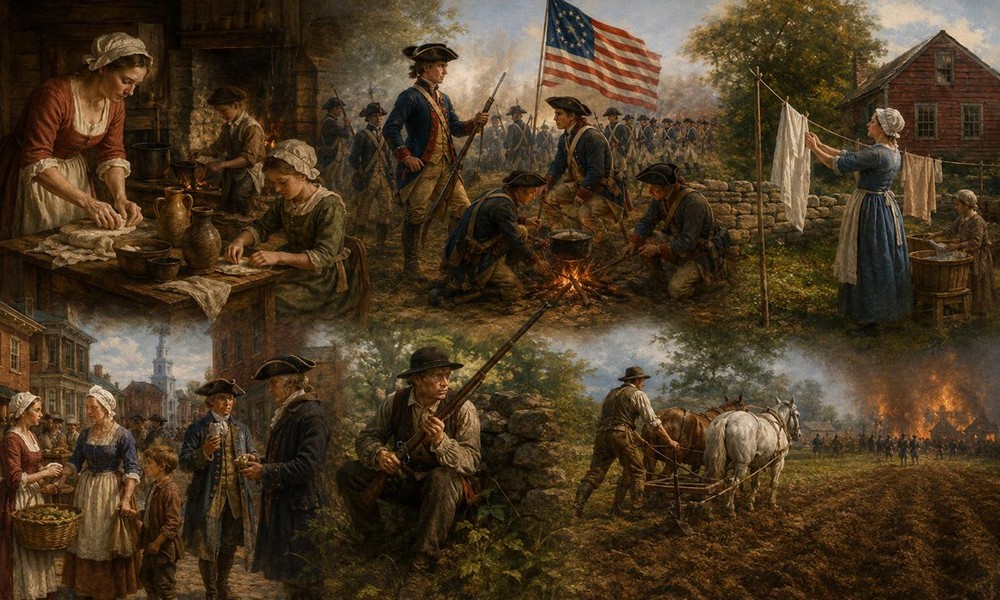
Exploring How Ordinary Colonists Lived, Worked, and Adapted During a Time of Conflict.
People often remember the American Revolution through dramatic images of battlefield victories, famous speeches, and influential leaders such as George Washington and Thomas Jefferson. While military campaigns and political developments undoubtedly shaped the course of history, the Revolution was also experienced by millions of ordinary people whose daily lives were transformed by the conflict.
Farmers, merchants, women, children, enslaved individuals, Indigenous communities, artisans, and soldiers all faced significant challenges as war disrupted routines, altered economies, divided families, and reshaped society. For many colonists, the American Revolution was not simply a political movement discussed in meeting halls-it was a reality that affected how they worked, traveled, shopped, ate, and interacted with their communities.
Understanding everyday life during the American Revolution provides a more complete picture of this pivotal era. It highlights the resilience of ordinary people while illustrating how large historical events influence daily experiences. By examining the social, economic, and personal dimensions of life during the Revolution, we gain a deeper appreciation for the complexities of America’s founding period.
“The American Revolution was fought not only on battlefields but also in homes, farms, workshops, and communities where ordinary people adapted to extraordinary circumstances.”
Daily Life Before and During the Revolution
Before the outbreak of war, life in the thirteen colonies varied considerably depending on geography, occupation, wealth, and social status. Most colonists lived in rural areas and relied heavily on agriculture for their livelihoods.
Daily activities often centered around:
- Farming and food production
- Household responsibilities
- Religious observance
- Community gatherings
- Trade and craftsmanship
- Seasonal labor
The onset of revolutionary conflict disrupted many aspects of this routine.
Military campaigns affected transportation routes, markets, and local economies. Communities sometimes found themselves occupied by British or Patriot forces, creating uncertainty and instability.
Even those living far from major battles experienced changes resulting from:
- Supply shortages
- Rising prices
- Political tensions
- Increased taxation and regulations
- Military recruitment efforts
The Revolution became woven into nearly every aspect of colonial life.
Family Responsibilities and Household Life
Families played a central role in colonial society, and households functioned as important centers of economic activity.
During the Revolution, many families faced additional burdens due to the absence of men serving in militias or the Continental Army.
Women frequently assumed expanded responsibilities, including the following:
Managing Farms and Businesses
Many women oversaw agricultural operations, supervised workers, and handled financial matters while male family members participated in military service.
Producing Household Goods
Families often relied on homemade products such as:
- Clothing
- Candles
- Soap
- Preserved foods
The encouragement of boycotts against British imports further increased domestic production.
Supporting the War Effort
Women contributed by:
- Sewing uniforms
- Preparing supplies
- Providing medical assistance
- Raising funds for soldiers
Children also played important roles within households by assisting with chores, caring for siblings, and helping maintain family livelihoods.
The war often required families to demonstrate remarkable adaptability and resourcefulness.
Food, Farming, and Economic Challenges
Agriculture formed the foundation of colonial life, with most families engaged in farming to some degree.
Common crops varied by region and included:
- Corn
- Wheat
- Tobacco
- Rice
- Indigo
- Vegetables and fruits
Livestock such as chickens, pigs, and cattle also contributed to household sustenance.
The Revolution disrupted food production and distribution in several ways.
Military Demands
Armies required significant quantities of food and supplies, sometimes purchasing provisions and other times requisitioning them from local communities.
Trade Disruptions
British blockades and wartime instability affected the availability of imported goods.
Inflation and Scarcity
Supply shortages contributed to rising prices, making basic necessities more difficult to obtain.
Property Damage
Battles occasionally resulted in destroyed crops, damaged farms, and displaced populations.
Despite these challenges, many colonists relied upon local networks and self-sufficiency to meet their needs.
Home gardens, food preservation techniques, and community cooperation became increasingly important during periods of uncertainty.
“For ordinary families, the Revolution often meant balancing patriotism with the practical challenges of feeding households and maintaining livelihoods.”
Education, Religion, and Community Life
Although wartime conditions created disruptions, many aspects of community life continued throughout the Revolution.
Education
Educational opportunities varied significantly.
Children from wealthier families sometimes attended formal schools or received instruction from tutors.
Others learned practical skills through apprenticeships or family instruction.
The war occasionally interrupted schooling due to:
- Teacher shortages
- Military occupation
- Economic hardship
- Community instability
Nevertheless, education remained valued as many Americans increasingly associated knowledge with informed citizenship.
Religion
Religious institutions continued to play important social and spiritual roles.
Churches served as places for:
- Worship
- Community gatherings
- Sharing information
- Offering support during difficult times
Religious affiliations sometimes intersected with political loyalties, influencing perspectives on the Revolution.
Community Networks
Neighbors frequently assisted one another through the following:
- Shared labor
- Resource exchanges
- Mutual aid
- Local committees supporting the Patriot cause
Strong community ties helped many individuals navigate wartime challenges.
The Experiences of Diverse Groups During the Revolution
Everyday life during the Revolution differed substantially depending on social status, race, gender, and political allegiance.
Enslaved Individuals
For enslaved Africans and African Americans, the Revolution presented both opportunities and uncertainties.
Some sought freedom by joining British forces after promises of emancipation were offered.
Others served with Patriot forces or continued living under slavery despite revolutionary rhetoric emphasizing liberty.
The Revolution intensified discussions regarding freedom while exposing contradictions within colonial society.
Indigenous Communities
Native American nations faced difficult decisions regarding alliances.
Many sought neutrality, while others aligned with British or American forces based on strategic considerations.
The Revolution often disrupted Indigenous communities and contributed to future territorial conflicts.
Loyalists
Not all colonists supported independence.
Loyalists-those who remained loyal to Britain-sometimes faced:
- Social isolation
- Property confiscation
- Violence or intimidation
- Forced migration following the war
The Revolution divided communities and occasionally even families.
Understanding these diverse experiences highlights the complexity of everyday life during this period.
Soldiers and Civilian Interactions
Military service brought significant hardships for soldiers in the Continental Army and local militias.
Common challenges included:
- Limited food supplies
- Inadequate clothing
- Harsh weather conditions
- Disease outbreaks
- Irregular pay
Civilians frequently interacted with military personnel through billeting troops.
Billeting Troops
Families sometimes housed soldiers temporarily.
Providing Supplies
Communities contributed food, livestock, and equipment to support military efforts.
Nursing the Sick and Wounded
Women often played important caregiving roles during and after battles.
During wartime, particularly in areas experiencing active conflict, the distinction between civilian and military life often blurred.
Shared sacrifices strengthened support for independence among some colonists while increasing fatigue and hardship for others.
How the Revolution Changed Daily Life
The American Revolution transformed colonial society in lasting ways.
Following independence, Americans continued grappling with questions regarding the following:
- Government structure
- Individual rights
- Economic development
- Citizenship
- Social equality
Although many aspects of daily life eventually returned to normal patterns, the Revolution altered how Americans viewed authority, participation in government, and national identity.
Ordinary people who endured wartime challenges contributed significantly to the success of the revolutionary movement.
Their experiences remind us that history is shaped not only by prominent leaders but also by countless individuals navigating everyday life during extraordinary times.
Studying these personal experiences gives valuable insight into the human dimensions of the American Revolution.
Frequently Asked Questions
What was everyday life like during the American Revolution?
Daily life involved managing households, farming, coping with shortages, supporting military efforts, and adapting to social and economic disruptions caused by the war.
How did women contribute during the American Revolution?
Women managed households, operated farms and businesses, produced goods, cared for soldiers, and supported Patriot efforts in numerous ways.
How did the war affect colonial families?
Families often experienced separation, financial hardship, supply shortages, and increased responsibilities due to military service.
Did everyone support American independence?
No. Loyalists remained supportive of Britain, while others attempted neutrality or held differing perspectives regarding the conflict.
How did the Revolution affect enslaved people and Indigenous communities?
Experiences varied widely, with some seeking opportunities for freedom or strategic alliances while facing significant uncertainties and challenges.